Positive signals from early vessel calls
Nearly four months after welcoming its first cargo ship on July 15, 2026, My Thuy International Port has gradually demonstrated its capability to accommodate and service transport vessels. Ships berthing at the port, alongside ongoing cargo loading, unloading, and transport operations, have created a new trading rhythm across the southern coastal area of Quang Tri.
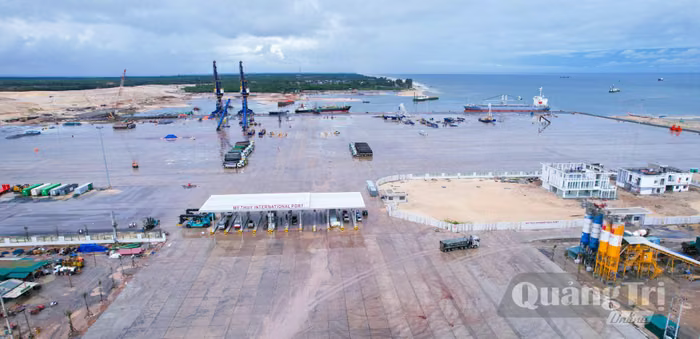
My Thuy International Port is gradually completing synchronized infrastructure to enhance trading capacity and diversify export–import markets and commodities. (Photo: L.T)
Visiting the My Thuy International Port Terminal Area in early November 2026, reporters observed a bustling atmosphere. At the time, the Philippine-flagged vessel TokiHime was docked at the port to load over 13,000 tonnes of export sand. This is one of several high-tonnage shipments passing through this new port complex, generating positive signals as the maritime infrastructure enters operation while underscoring the need to improve service quality, ensure cargo-handling schedules, and maintain maritime safety to build trust with partners.
Putting Berths No. 1 and No. 2 into operation in July 2026 marked a significant milestone for the My Thuy International Port Terminal Area Project. This development carries great importance for enhancing cargo throughput capacity, connecting Quang Tri with domestic and international economic hubs, and expanding coastal development space for industry, services, and logistics.
According to the Cua Viet Port Border Gate Customs under Regional Customs Sub-department IX, from the beginning of the year through October 31, 2026, import and export cargo throughput via My Thuy International Port and Cua Viet Port reached nearly 475,300 tonnes, with a turnover exceeding USD 215.2 million, contributing nearly VND 145 billion to the state budget.
Alongside the My Thuy International Port Terminal Area, cargo transport and import–export activities at Cua Viet Port continue to affirm its role as a key maritime trade hub in southern Quang Tri Province. These cargo flows not only serve the production and business operations of enterprises, but also generate state budget revenue and sustain transport, warehousing, and stevedoring services. By the end of October 2026, import–export cargo volume via Cua Viet Port reached 336,903 tonnes with a turnover of USD 204.56 million, contributing VND 113.2 billion to the state budget.
Currently, continued infrastructure improvements in the Cua Viet port area, coupled with the implementation progress of the CFG Nam Cua Viet Project, will create further favorable conditions for waterway trade activities.
Synchronizing infrastructure to enhance connectivity
With an expanded development space following the merger, goods from western Quang Tri now follow economic corridors to converge at Cua Viet, My Thuy, and Hon La ports before heading out to the East Sea. Conversely, these seaports will open shorter and more convenient connecting routes, enabling inland regions to access international supply chains and turning geographical advantages into economic strengths. Notably, the province has resolved to shift from developing individual sectors in isolation to fostering an integrated marine economic ecosystem—where seaports are linked with logistics; logistics with economic zones and industrial parks; industry with energy; urban areas and tourism with culture and ecology; and marine economic hubs connect directly to border gates and international corridors.
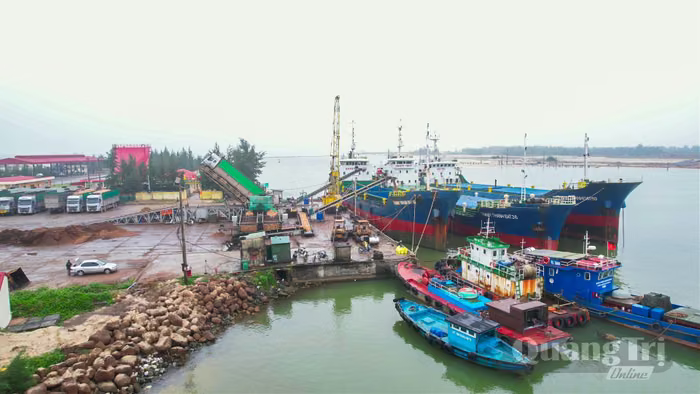
Cargo transport and import–export activities at Cua Viet Port continue to affirm its role as a maritime trade hub in southern Quang Tri Province. (Photo: L.T)
Therefore, alongside completing the seaport system, investing in connecting transport infrastructure has a direct impact on operational efficiency. Seamless transport routes will facilitate cargo organization, expand the port’s catchment area, and improve accessibility for businesses. This also serves as a foundation to attract warehousing, freight forwarding, distribution, and other supporting services.
Le Mai Anh, Head of Cua Viet Port Border Gate Customs under Regional Customs Sub-department IX, noted that the operation of My Thuy International Port has generated positive signals, helping enhance trading capacity and diversify import–export markets and commodities. The port also creates favorable conditions for enterprises to expand production and business, reduce logistics costs, shorten transit times, and strengthen cargo connectivity along the East–West Economic Corridor.
In the coming time, once the port is fully invested in and synchronously operated, it is expected to attract an increasing number of domestic and international enterprises and cargo sources, creating positive growth momentum for import–export activities, transit cargo transport, and logistics services. Accordingly, the priority is to continue completing connecting infrastructure, warehousing, and cargo-handling equipment, while strengthening coordination among port operators, transport providers, and regulatory agencies to improve customs management efficiency, reform administrative procedures, apply information technology, and facilitate trade.
Furthermore, port operations must ensure maritime safety, control dust and wastewater, and minimize impacts on residential areas—essential conditions for sustainable throughput growth.
To turn this orientation into reality, Quang Tri needs to concentrate resources on completing ongoing projects, resolving bottlenecks in site clearance and administrative procedures, and ensuring synchronized progress between seaports and connecting infrastructure. Investment attraction should also target manufacturing and service sectors capable of generating stable cargo flows and added value for the locality.
Source: Le Truong – Bao Moi