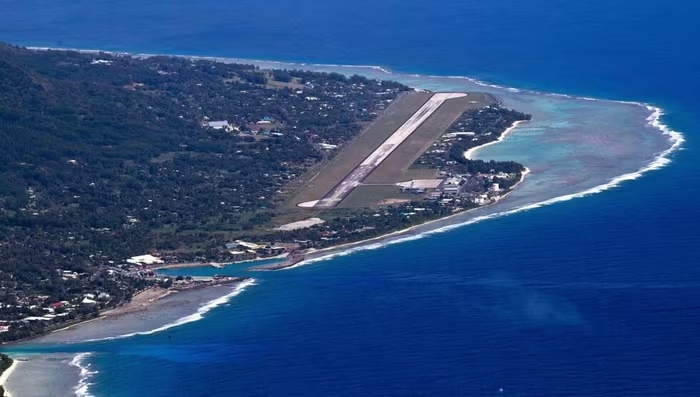
The Cook Islands is one of the top flag states used by 'underground' tankers transporting Russian crude, according to a European Parliament briefing. (Photo: Marty Melville/AFP0)
Dozens of tankers suspected of illegally shipping crude to Russia and Iran have used a small coastal office in the South Pacific to hide their activities, sanctions data analysis shows. Next to a pizza shop in the remote Cook Islands is the humble headquarters of one of the world’s fastest-growing ship registries.
Foreign ship owners don’t need to set foot on the island nation. They can fly the Cook Star flag by paying a fee to the Maritime Cook Islands.
According to US sanctions data, 20 Cook-flagged vessels are suspected of smuggling Russian and Iranian fuel in 2024-2025. Another 14 Cook-flagged vessels were also placed on a separate UK sanctions list during the same period.
New Zealand, Cook's closest diplomatic partner, expressed "concern and outrage" at seeing sanctions efforts being thwarted.
“New Zealand continues to have serious concerns about the way the Cook Islands manages its ship register, something we have raised with the Cook Government on numerous occasions over a number of years,” a spokesman for Foreign Minister Winston Peters said. “This is a completely unacceptable and unsustainable deviation from foreign policy,” he said.
The Cook Islands are self-governing but maintain “free association” with New Zealand. Wellington retains responsibility for some areas such as defence and foreign affairs.
The Maritime Cook Islands, which manages the ship register, has denied allegations of lax inspections or tolerance of violators, insisting that all sanctioned vessels have been removed from the register.
Western sanctions are aimed at restricting Iran and Russia from earning oil revenues, thereby choking off funding for Tehran’s nuclear program and the Russia-Ukraine conflict. “There are some countries that have signed the Russian sanctions and absolutely will not allow these ships to fly their flag,” said Anton Moiseienko, an expert on sanctions and financial crime at the Australian National University. “But there are also countries that are more lenient. That’s where the Cook Islands come in,” he added.
A UAE-based shipping company was accused of smuggling “millions of dollars” of fuel to Iran’s military in the Gulf in April. The company owns ships flying flags from Barbados, Gambia, Panama and the Cook Islands, according to US sanctions data.
Such vessels are believed to be part of a maritime smuggling network, known as a “secret fleet”, which operates by disguising itself as legitimate cargo vessels to evade sanctions.
They cover their tracks by registering in places like the Cook Islands, where regulations are lax. Often, even the registry has no idea what the vessel is actually being used for.
Last year, Lloyd's List, a shipping magazine, ranked the Maritime Cook Islands as one of the world's "fastest-growing registers ." "There are quite a few Cook Islands-flagged vessels that are identified as part of secret fleets," Moiseienko said. "For flag states like the Cook Islands, Liberia and others, there is virtually no international mechanism to enforce their obligations," he noted.
The register was brought to the spotlight a few months later when an oil tanker, the Eagle S, damaged five submarine cables in the Baltic Sea. Finnish investigators suspect that the Cook Islands-flagged vessel – believed to be part of a secret Russian fleet – may have sabotaged the cables by dragging its anchors into the seabed.
Ship registries are also an important source of revenue for many budget-strapped Pacific island nations. But these registries, often run as private businesses, have repeatedly run into trouble.
North Korean smuggling networks have long exploited the ship registries of South Pacific island nations such as Palau , Niue and Tuvalu. Many, including the Cook Islands, do not publicly disclose registration fees.
However, an estimate from Palau suggests a 30,000-tonne tanker could cost around $10,000 in registration fees.
Ship registries that allow foreign ships to fly their flags are commonly known as “flags of convenience”.
“Many vessels in the clandestine fleet fly flags of convenience from countries that are less able, or do not, enforce Western sanctions,” according to a 2024 European Parliament report.
The Cook Islands was ranked among the “flag states most frequently used by the secret fleet to transport Russian crude oil,” according to the same report.
The Royal United Services Institute (UK) said Iran and North Korea have been exploiting small vessel registers for years. However, the clandestine fleet’s activities “expanded significantly” after Russia was hit with heavy sanctions for its aggression in Ukraine, the institute said in September.
The Maritime Cook Islands operates the ship register as a private company “under authority” from the government and is supervised by the island nation’s transport authority .
According to Cook Islands budget documents, revenue from vessel registration fees has increased by more than 400% over the past five years, and was expected to reach $175,000 in the last financial year.
Maritime Cook Islands insists that all vessels accused of evading sanctions are promptly removed from the register. Sometimes, the vessels in question are removed before they are named in sanctions. “The Cook Islands Register has never contained a sanctioned vessel. All sanctioned vessels are removed,” the company stressed.
They also denied failing to conduct proper checks before registering suspicious vessels. The Cook Islands Register has the infrastructure to effectively monitor and detect illegal activities.