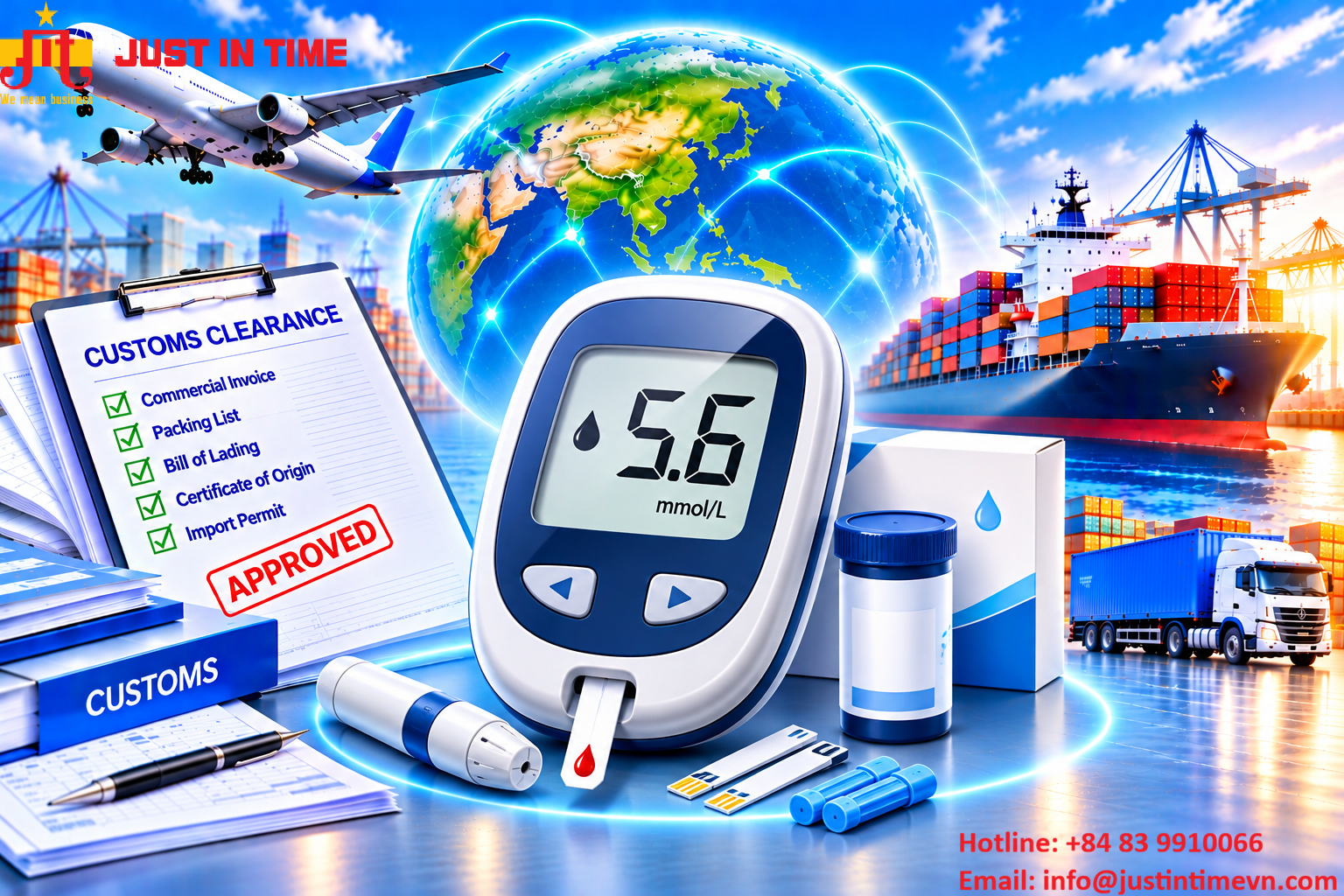
1. Blood Glucose Meter Products and Import Policies
Blood glucose meters imported into Vietnam include various products, such as personal glucose meters, meters supplied with test strips, continuous glucose monitoring devices, and meters used in healthcare facilities.
Blood glucose meters are managed as medical devices. The applicable import policy depends on the product type, medical device classification, condition of the goods, and intended use.
Before importing blood glucose meters, businesses should pay attention to the following requirements:
-
Import policy: New blood glucose meters are not on the list of goods prohibited from import, but they must comply with medical device regulations.
-
Business requirements: The importer should have suitable business lines and meet the conditions set out in medical device regulations.
-
Medical device classification: The product must be classified by risk level into group A, B, C, or D. Blood glucose meters and test strips are usually classified in group C, but businesses should rely on the actual classification result to determine the documents and procedures required.
-
Medical device declaration: Businesses need to complete the declaration or circulation registration procedure for the relevant group on the medical device management portal.
-
Used goods: Used medical devices may fall under the list of goods prohibited from import. Businesses should check the current regulations before entering into a transaction.
-
Goods labeling: Imported blood glucose meters must comply with Vietnam's regulations on goods labels and medical device labels.
Businesses should check the relevant regulations before signing a purchase contract or arranging shipment to Vietnam.
2. HS Codes for Blood Glucose Meters
Identifying the correct HS code is an important step in the blood glucose meter import process. The HS code affects import duties, value-added tax (VAT), and any applicable management requirements.
The following HS code is provided for reference:
|
HS Code |
Product Group |
|
9027.89.90 |
Blood glucose meters (other analytical instruments and apparatus) |
The specific HS code depends on the actual characteristics of the goods, including:
-
Measuring principle and analytical functions of the device.
-
Whether the meter is imported alone or with test strips and lancets.
-
Whether the goods are complete products or separate parts and accessories.
-
Intended use, where relevant to classification.
Note: The HS code above is for reference only. The exact HS code must be determined based on the actual technical specifications of the product and the applicable Vietnamese Nomenclature of Exports and Imports. Products with similar trade names may still fall under different HS subheadings; for example, glucose test strips are usually classified separately from the meter.
3. Import Duties and VAT
Taxes applicable to imported blood glucose meters generally include import duty and value-added tax (VAT).
Import Duty
The import duty rate depends on the HS code, the country of origin, and the applicable tariff schedule.
Depending on the shipment, businesses may be eligible for special preferential import duty rates under relevant free trade agreements if the goods meet the rules of origin and are supported by the required documents.
A C/O may be required to apply special preferential rates. Businesses should check the eligibility conditions before the goods are shipped.
Value-Added Tax (VAT)
VAT applies in accordance with the tax regulations in force for imported goods. Businesses should check the applicable rate for the specific product at the time the customs declaration is registered.
Reference Tax Formulas
The CIF value includes the price of the goods plus freight and insurance to the first port of entry in Vietnam. If goods are purchased under other delivery terms, businesses need to convert the value to the dutiable value in accordance with regulations.
How to Determine the Taxes Payable
To determine the taxes payable, businesses need to clarify:
-
The correct HS code of the goods.
-
The customs value of the shipment.
-
The country of origin.
-
Eligibility for special preferential import duty rates.
-
The applicable import duty and VAT rates.
Tax rates may change. Businesses should verify the applicable regulations at the time the customs declaration is registered.
** See more Blood Pressure Monitor Import Procedures
4. Blood Glucose Meter Import Documents
The import documents for blood glucose meters depend on the product type and the relevant customs and medical device requirements.
A typical import dossier may include:
-
Customs declaration: The import declaration submitted through the customs system.
-
Commercial Invoice: The invoice issued by the seller.
-
Packing List: Shows packages, quantities, and weights.
-
Sales Contract: When required.
-
Bill of Lading (B/L) or Air Waybill (AWB): The transport document corresponding to the shipping method.
-
Certificate of Origin (C/O): When applicable, especially when claiming special preferential import duty rates.
-
Technical documents: Catalogues, technical specifications, or other documents used to identify the goods.
-
Medical device documents: The classification result and the declaration number or circulation documents for the relevant device group.
For original documents such as the bill of lading and C/O, businesses should ask the seller to send them in advance to avoid container detention and storage charges when the goods arrive.
Not every shipment requires all of the documents above. Businesses should identify the exact documents needed before shipment.
5. Blood Glucose Meter Import Process
The blood glucose meter import process generally includes the following steps:
Step 1: Identify the product
Collect information from the supplier about the model, operating principle, functions, condition of the goods, manufacturer, and technical documents. This is the basis for determining the HS code and applicable import policies.
Step 2: Check import policies
Determine the conditions for the importer and the medical device requirements that apply to the product.
Step 3: Classify and declare the medical device
Classify the risk level and complete the declaration or circulation registration procedure for the device group. Businesses should complete this step before the goods arrive to avoid storage charges.
Step 4: Determine the HS code
Classify the goods based on their actual characteristics and the applicable Vietnamese Nomenclature of Exports and Imports. Additional technical documents may be required if the product is difficult to classify.
Step 5: Calculate taxes and check origin
Determine the applicable import duty and VAT. Check eligibility for special preferential rates under trade agreements and the validity of the C/O.
Step 6: Check goods labeling
Ensure that the goods comply with Vietnamese regulations on original labels and supplementary labels. Label information should be consistent with the import documents and the declaration dossier.
Step 7: Prepare import documents
Prepare the commercial invoice, packing list, transport document, sales contract if required, C/O if applicable, and the necessary medical device documents.
Step 8: Submit the customs declaration
Declare the imported blood glucose meters through the electronic customs system within the prescribed time limit, generally before the goods arrive or within 30 days from the date the goods arrive at the border gate. Ensure that the description, HS code, quantity, customs value, and origin are consistent with the supporting documents.
Step 9: Complete required inspections
Depending on the declaration channel (green, yellow, or red), businesses present documents or goods for customs inspection and complete the corresponding requirements in accordance with regulations.
Step 10: Pay import taxes
Pay import duty, VAT, and any other applicable charges in accordance with regulations.
Step 11: Complete customs clearance
After meeting customs requirements and related procedures, the shipment may be cleared by the customs authority. Businesses then complete the necessary procedures to receive the goods and transport them to the warehouse.
Step 12: Fulfil remaining requirements
Complete any remaining requirements for goods labeling, medical device documents, or other management procedures, if applicable, before the goods are distributed or used.
6. Important Notes When Importing Blood Glucose Meters
Businesses should pay attention to the following issues when importing blood glucose meters into Vietnam:
-
Identify the correct HS code: Do not classify goods based on trade names alone. Classification should be based on the operating principle and actual characteristics of the product. Incorrect HS declarations may lead to clearance delays, tax arrears, and administrative penalties.
-
Declare before importing: Complete the medical device classification and declaration before the goods arrive to avoid storage charges.
-
Check the importer's eligibility: Not every business can import right away. Review the business lines and the conditions for trading in medical devices.
-
Check the C/O: Ensure the C/O and the goods meet the relevant rules of origin before claiming preferential rates.
-
Prepare consistent documents: Discrepancies between the invoice, packing list, transport document, and technical documents may lead customs to request explanations.
-
Comply with labeling regulations: Check the requirements for original and supplementary labels.
-
Calculate total import costs: In addition to taxes, consider freight, insurance if any, port charges, handling fees, storage, declaration fees, and customs brokerage services.
-
Stay updated on current regulations: Medical device regulations and tax rates may change. Businesses should verify them before each shipment.
Thorough preparation before the goods arrive helps reduce the risk of clearance delays and additional costs.
** See more Pulse Oximeter Import Procedures
7. Blood Glucose Meter Import Services
Businesses may use customs brokerage or import logistics services to support the blood glucose meter import process.
Depending on the scope of the service, providers may assist with:
-
Reviewing technical specifications and advising on HS codes.
-
Checking import policies and medical device requirements.
-
Estimating import duty and VAT.
-
Checking commercial documents, the C/O, and goods labels.
-
Preparing and submitting customs declarations.
-
Coordinating required inspections.
-
Arranging transport and delivery after clearance.
Before using a service, businesses should clarify the scope of work, costs, responsibilities of each party, and any fees not included in the quotation.
Importers remain responsible for ensuring that the information and documents provided for customs declaration are accurate and complete.
8. Frequently Asked Questions (FAQ)
1. Do blood glucose meters require an import license in Vietnam?
The requirements depend on the medical device classification and the regulations in force. Businesses should check the declaration or circulation registration procedure that applies to the product before importing.
2. Do blood glucose meters require a medical device declaration?
Blood glucose meters are managed as medical devices, so they need to be classified and go through the procedure for the relevant device group. Businesses should complete this procedure before the goods arrive.
3. What is the HS code for blood glucose meters?
Blood glucose meters may be considered under code 9027.89.90. Test strips and accessories may fall under other HS codes. The specific HS code depends on the actual characteristics of the product and the applicable Nomenclature of Exports and Imports.
4. What taxes apply to imported blood glucose meters?
Imported blood glucose meters are generally subject to import duty and VAT. The amount depends on the HS code, customs value, country of origin, and current regulations.
5. Is a C/O required for importing blood glucose meters?
A C/O may be required to claim special preferential import duty rates under relevant trade agreements. Businesses should check the rules of origin and documentation requirements before the goods are shipped.
6. Is a catalogue required for importing blood glucose meters?
A catalogue is not necessarily mandatory for every shipment. However, catalogues, technical specifications, and related documents may be needed to determine the HS code, classify the device, or respond to customs explanation or inspection requests.
7. Can used blood glucose meters be imported into Vietnam?
Used medical devices may fall under the list of goods prohibited from import. Businesses should check the applicable policies before entering into a transaction or arranging shipment.
9. Conclusion
Blood glucose meter import procedures in Vietnam require businesses to identify the correct HS code, determine import duties and VAT, classify and declare the medical device, and prepare the necessary import documents.
Because requirements may vary according to product characteristics, device group, country of origin, and applicable regulations, businesses should verify the relevant policies before shipment. Proper preparation helps reduce customs delays, control import costs, and ensure compliance with Vietnamese regulations.
If you have difficulties when clearing customs, you can choose Just In Time as a companion.
Just In Time's staff is always enthusiastic to support you to handle your work quickly and professionally.
JUST IN TIME JOINT STOCK COMPANY
Address: No. 5, Dong Da, Tan Son Hoa Ward, Ho Chi Minh City.
Hotline: +84 83 9910066
Email: info@justintimevn.com
Facebook: https://www.facebook.com/justintimevn
** See more Electronic Thermometers Import Procedures