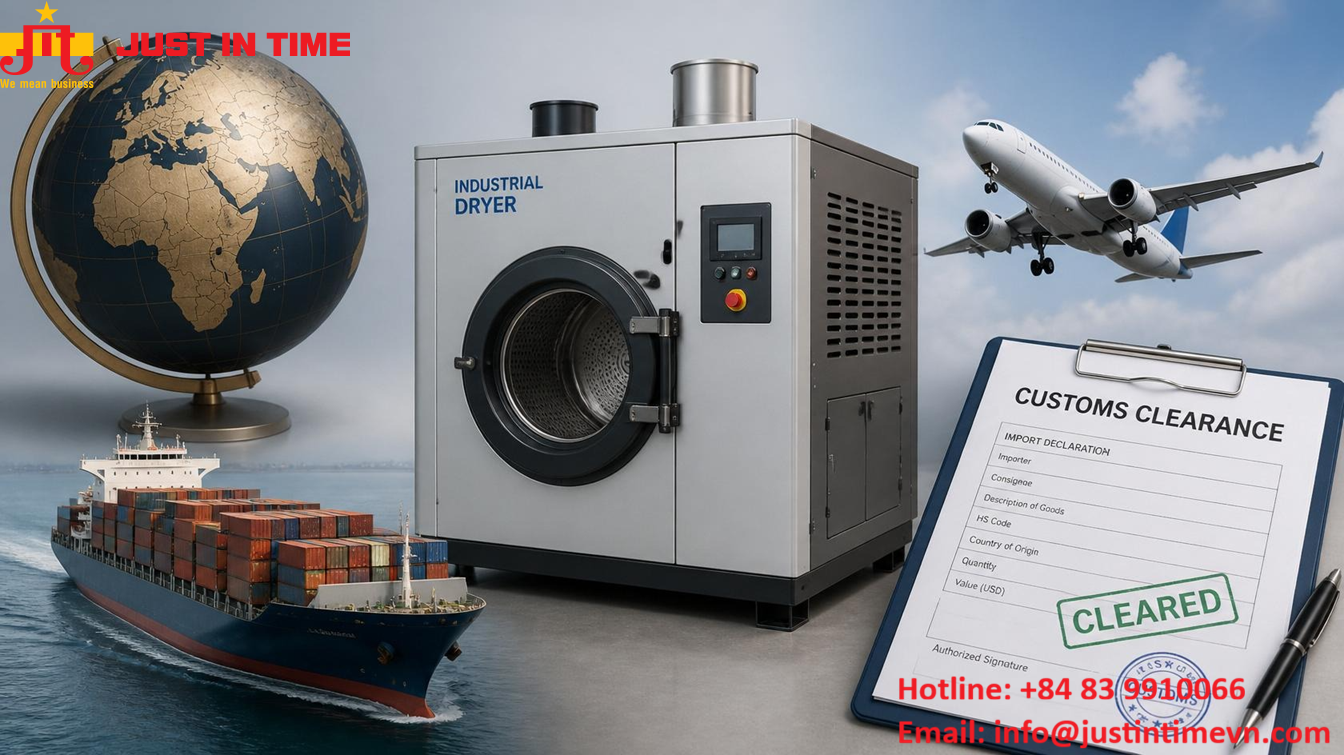
1. Overview of Industrial Drying Machines and Import Policies
Industrial drying machines are designed to remove moisture from materials using heat, hot air, vacuum technology, infrared radiation, microwave technology, or other drying methods.
Common types of industrial drying machines include:
-
Food drying machines
-
Agricultural product dryers
-
Seafood drying machines
-
Tray dryers
-
Belt dryers
-
Fluidized bed dryers
-
Rotary drum dryers
-
Vacuum dryers
-
Spray dryers
-
Wood drying machines
-
Textile dryers
-
Chemical material dryers
In Vietnam, brand-new industrial drying machines are generally allowed to be imported. However, importers must comply with:
-
Regulations on industrial machinery and equipment management
-
Electrical and occupational safety regulations
-
Product labeling requirements
-
Regulations on used machinery if importing second-hand equipment
-
Applicable tax obligations
For specialized drying machines used in food processing, pharmaceuticals, chemicals, or other specific manufacturing sectors, importers should check whether additional specialized management requirements apply before shipment.
2. HS Codes for Industrial Drying Machines
2.1 Reference HS Codes
Industrial drying machines are generally considered for classification under HS heading 8419, which covers machinery and equipment used to treat materials through processes involving changes in temperature.
Reference HS codes may include:
-
HS 8419.33 Freeze-drying equipment
-
HS 8419.34 Drying equipment for agricultural products
-
HS 8419.35 Drying equipment for wood, paper pulp, paper, or paperboard
-
HS 8419.39 Other drying equipment
-
HS 8419.39.90 Other industrial drying machines, depending on their actual design and intended use
These HS codes are provided for reference purposes only. The exact HS code must be determined based on the machine’s structure, operating principle, material being dried, and primary function.
2.2 How to Determine the Correct HS Code
The HS classification of an industrial drying machine should be based on:
-
Drying technology
-
Type of material or product being dried
-
Heat source
-
Operating temperature and capacity
-
Equipment structure and components
-
Whether the machine operates independently or as part of a production line
-
Technical catalog and manufacturer documentation
Importers should prepare product catalogs, photographs, operating diagrams, and detailed descriptions of the machine’s functions to support HS classification.
3. Import Duties for Industrial Drying Machines
When importing industrial drying machines, businesses may be required to pay:
-
Preferential import duty
-
Value-added tax
-
Other charges arising under applicable goods policies
The import duty depends on:
-
HS code
-
Country of origin
-
Applicable tariff schedule at the time of customs declaration
-
Availability of a valid Certificate of Origin
When a valid Certificate of Origin is available, the importer may qualify for special preferential import duty rates under the relevant free trade agreement.
Common Certificates of Origin include:
-
C/O Form E for goods originating from China
-
C/O Form D for goods originating from ASEAN countries
-
C/O Form AK for goods originating from South Korea
-
C/O Form AJ or VJ for goods originating from Japan
-
C/O Form EUR.1 for goods covered by the EVFTA
-
CPTPP Certificate of Origin for goods covered by the CPTPP
Value-added tax must be determined according to the tax policy applicable to the relevant HS code at the time of importation.
** See more Industrial Air Coolers Import Procedures
4. Required Documents for Importing Industrial Drying Machines
A standard customs documentation set normally includes:
-
Customs declaration
-
Commercial invoice
-
Packing list
-
Sales contract
-
Bill of Lading or Air Waybill
-
Certificate of Origin if applicable
-
Product catalog
-
Manufacturer’s technical documentation
Depending on the shipment, importers may also need to prepare:
-
Product photographs
-
Operating principle diagrams
-
Detailed descriptions of the machine’s functions
-
Documents showing operating capacity and temperature
-
Inspection certificates for used machinery
-
Specialized management documents if applicable
Information concerning the product name, model, capacity, country of origin, and manufacturer must be consistent across the commercial documents, technical documents, and product labels.
5. Import Procedures for Industrial Drying Machines
Step 1: Identify the machine type and intended use
Determine whether the machine is designed to dry food, agricultural products, seafood, wood, textiles, chemicals, or other industrial materials.
Step 2: Determine the HS code and import policy
Use the machine’s structure, function, drying technology, and technical documentation to determine the appropriate HS code and duty rate.
Step 3: Verify the equipment condition
Determine whether the machine is brand new or used.
Step 4: Prepare the import documentation
Check that the commercial invoice, packing list, Bill of Lading, sales contract, Certificate of Origin, and product catalog are complete and consistent.
Step 5: Submit the customs declaration
Declare the shipment electronically through the VNACCS system.
Step 6: Complete procedures according to the customs channel
Depending on the customs channel assignment, the importer may complete immediate clearance, submit documents for inspection, or coordinate a physical inspection of the goods.
Step 7: Pay taxes and complete customs clearance
Fulfill all tax obligations and respond to any additional requests from customs authorities.
Step 8: Receive the goods and transport them to the warehouse
After customs clearance, take delivery of the equipment and arrange transportation, installation, and operation.
6. Importing Used Industrial Drying Machines
Used industrial drying machines may be imported if they satisfy the applicable conditions for second-hand machinery and equipment.
Importers should check:
-
Year of manufacture
-
Equipment age
-
Manufacturing standards
-
Remaining quality and condition
-
Operational safety
-
Energy efficiency
-
Inspection certificate
-
Model and serial number
Before purchasing used equipment, businesses should review all technical documents and import conditions to avoid additional storage charges, demurrage, detention, or re-export costs.
7. Product Labeling Requirements
Imported industrial drying machines must bear labels containing essential information such as:
-
Product name
-
Manufacturer’s name and address
-
Country of origin
-
Model number
-
Serial number, if applicable
-
Year of manufacture
-
Capacity
-
Voltage
-
Frequency
-
Main technical specifications
When the original label does not contain all mandatory information in Vietnamese, the importer must attach a supplementary Vietnamese label before placing the product on the market.
The information on the supplementary label must be consistent with the original label and the import documentation.
** See more Stretch Wrapping Machines Import Procedures
8. Important Notes When Importing Industrial Drying Machines
8.1 Distinguishing Drying Machines from Heating Furnaces
Importers must determine whether the equipment’s primary function is to remove moisture or merely to heat, bake, fire, or thermally process materials.
Industrial drying machines and heating furnaces may fall under different HS headings. An incorrect description of the equipment’s primary function may result in an incorrect HS code and duty rate.
8.2 Identifying the Material Being Dried
The HS code may vary depending on whether the machine is designed to dry:
-
Agricultural products
-
Food products
-
Seafood
-
Wood
-
Paper
-
Textiles
-
Chemicals
-
Minerals
-
Industrial components
The product catalog should clearly identify the type of material the machine is designed to process.
8.3 Checking Complete and Synchronized Systems
An industrial drying system may include:
-
Drying chamber
-
Circulation fans
-
Heating unit
-
Conveyor system
-
Control cabinet
-
Feeding system
-
Heat recovery system
-
Exhaust gas treatment system
Importers must determine whether the shipment constitutes a complete machine, a synchronized system, or several separately imported pieces of equipment to ensure proper customs declaration.
8.4 Checking Information Across Documents
The product description should clearly specify:
-
Machine type
-
Intended use
-
Model
-
Capacity
-
Voltage
-
Whether the machine is new or used
-
Manufacturer
-
Country of origin
A complete and accurate product description helps facilitate customs inspection and HS classification.
9. Industrial Drying Machine Import Services
Import support services may include:
-
Import policy consultation
-
HS code and duty consultation
-
Verification of used machinery import conditions
-
Review of documents before the goods arrive
-
Customs declaration services
-
Physical inspection support
-
International transportation
-
Transportation from the port to the warehouse
-
Support in resolving customs clearance issues
Working with an experienced service provider can help businesses reduce the risks of incorrect HS classification, missing technical documents, and additional container storage or port storage charges.
10. FAQ – Frequently Asked Questions About Importing Industrial Drying Machines
10.1 Do industrial drying machines require an import license?
Brand-new industrial drying machines generally do not require an import license. However, the intended use and any applicable specialized management policies should be reviewed before importation.
10.2 Are industrial drying machines subject to quality inspection?
Inspection requirements depend on the machine type, intended use, structure, and applicable specialized regulations.
10.3 Can used industrial drying machines be imported?
Yes. Used industrial drying machines may be imported if they meet all applicable conditions for second-hand machinery and equipment.
10.4 What is the HS code for industrial drying machines?
Industrial drying machines are generally considered for classification under HS heading 8419. The exact HS code depends on the drying technology, material being dried, and primary function of the equipment.
10.5 What is the import duty rate for industrial drying machines?
The import duty depends on the applicable HS code and country of origin. Importers should verify the tariff schedule in effect when the customs declaration is registered.
10.6 Is a product catalog required?
Yes. The product catalog and technical documentation are important for determining the machine’s function, HS code, and applicable import policy.
10.7 How long does customs clearance take?
Customs clearance generally takes from one to three working days when the documents are complete and no specialized inspection or classification consultation is required.
11. Conclusion
Industrial drying machines are important equipment used in many manufacturing and processing sectors. Because these machines vary in design and drying technology, importers must correctly determine their intended function, HS code, and applicable import policies before placing an order.
Preparing complete catalogs, technical documentation, commercial documents, and supporting records for used equipment will help ensure a smooth customs declaration and clearance process. Importers should also carefully check product labels and the consistency of all documents to reduce risks relating to duties, classification, and additional costs.
If you have difficulties when clearing customs, you can choose Just In Time as a companion.
Just In Time's staff is always enthusiastic to support you to handle your work quickly and professionally.
JUST IN TIME JOINT STOCK COMPANY
Address: No. 5, Dong Da, Tan Son Hoa Ward, Ho Chi Minh City.
Hotline: +84 83 9910066
Email: info@justintimevn.com
Facebook: https://www.facebook.com/justintimevn
** See more Hydraulic Press Machines Import Procedures