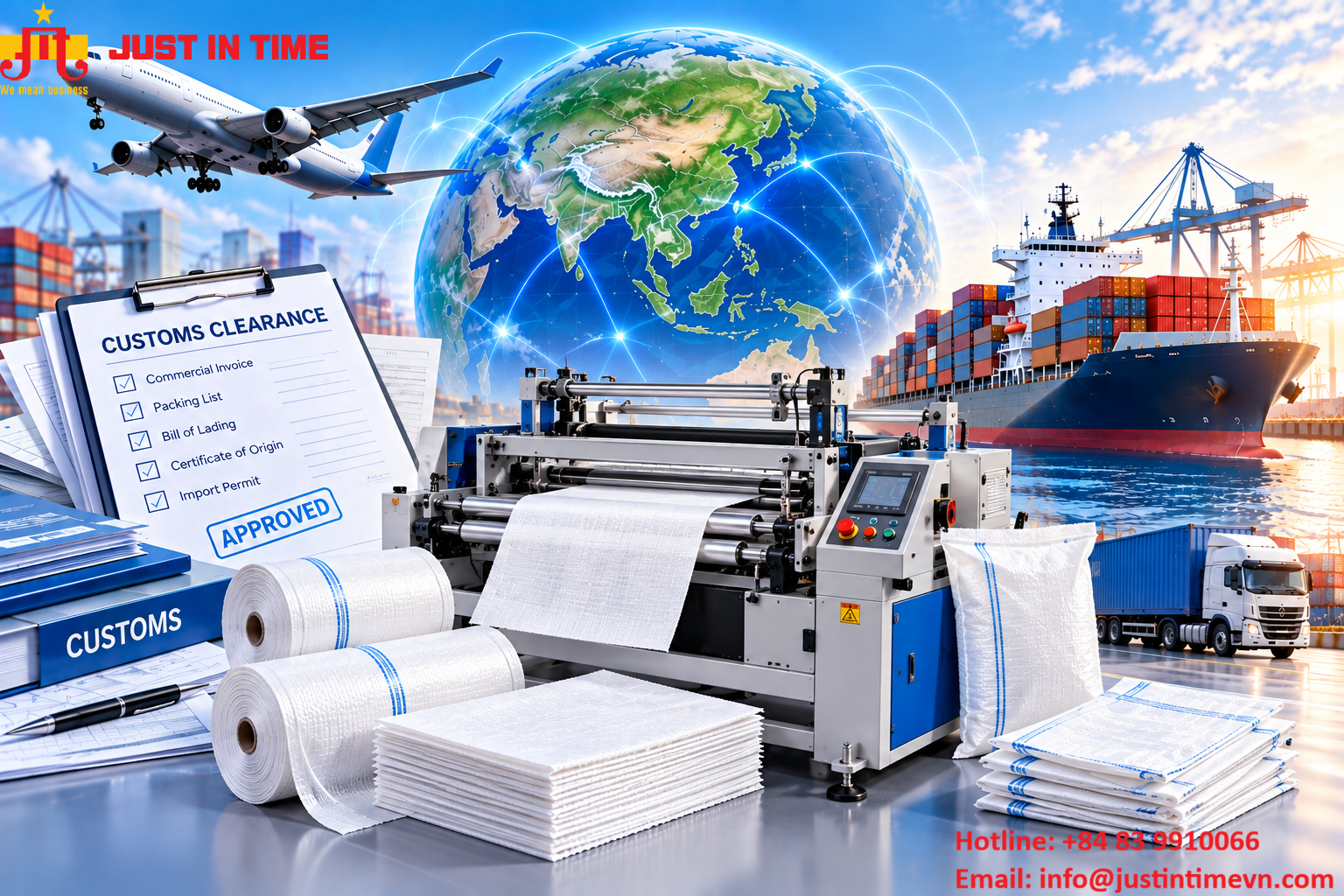
1. Product and Import Policy for PP Packaging Cutting Machines
1.1. What Is a PP Packaging Cutting Machine?
A PP packaging cutting machine is industrial equipment used to cut polypropylene plastic film or packaging materials into sections of specified dimensions.
Depending on its design and technology, the machine may perform one or more functions, including material feeding, film drawing, length measurement, thermal cutting, cold cutting, and finished-product counting.
Common types of packaging cutting machines include:
-
Automatic PP plastic film cutting machines.
-
Thermal cutting machines for PP packaging.
-
Plastic bag and film cutting machines.
-
Roll-to-length cutting machines for plastic film.
-
Woven PP bag cutting machines.
-
Plastic bag manufacturing machines integrating cutting and heat-sealing functions.
These machines may use servo motors, PLC controllers, HMI touchscreens, and thermal cutting systems. However, not all machines used for cutting PP packaging materials have the same structure or fall under the same HS code.
1.2. Import Policy for PP Packaging Cutting Machines
New PP packaging cutting machines are generally not classified as prohibited imports and typically do not require a separate import license unless they fall under other applicable specialized management requirements.
Businesses should check the following:
-
The HS code based on the machine's actual function and characteristics.
-
Import duties and VAT.
-
Imported machinery labeling requirements.
-
Import conditions for used machinery.
-
Other specialized management requirements, if applicable to the machine's configuration and intended use.
For new machinery, businesses generally follow standard customs procedures. For used machinery, additional requirements concerning equipment age, technical standards, and inspection documentation must be checked.
Circular No. 56/2026/TT-BKHCN, effective September 5, 2026, regulates the importation of used machinery and equipment under Chapters 84 and 85 when imported for manufacturing activities in Vietnam. The applicable criteria include equipment age and technical requirements relating to safety, energy efficiency, and environmental protection.
1.3. Regulations on Importing Used PP Packaging Cutting Machines
For used PP packaging cutting machines, businesses should verify the import conditions before signing a contract or making a deposit to the supplier.
Under Circular No. 56/2026/TT-BKHCN, the general criteria applicable to used machinery within its scope include:
-
The equipment must not exceed 10 years of age, except where specific industries are subject to different requirements under the relevant appendices.
-
The machinery must have been manufactured in compliance with relevant national technical regulations on safety, energy efficiency, and environmental protection, where applicable.
-
If no relevant national technical regulation exists, the machinery must satisfy the applicable technical indicators under Vietnamese standards or national standards of a G7 country or South Korea concerning safety, energy efficiency, and environmental protection.
-
The import dossier and inspection documentation must comply with current regulations.
A used PP packaging cutting machine classified under Chapter 84 may fall within the scope of these requirements if it is imported for manufacturing activities in Vietnam and meets the applicable conditions. Businesses should review all relevant criteria and exceptions before importing used machinery.
2. HS Codes for PP Packaging Cutting Machines
The HS code is the basis for determining import duties, VAT, and other management policies applicable to PP packaging cutting machines.
Based on the typical characteristics of electrically operated PP plastic film cutting machines, the goods may be considered for classification under heading 8477, which covers machinery for working rubber or plastics or for manufacturing products from these materials.
2.1. Reference HS Codes for PP Packaging Cutting Machines
The following HS codes should be considered for reference:
|
Reference HS Code |
Product Description |
|
8477.80.39 |
Other electrically operated machinery for working plastics or manufacturing products from plastics, not specified elsewhere in the relevant subheading |
|
8477.80.40 |
Machinery for working plastics or manufacturing products from plastics, not electrically operated, as described by the relevant subheading |
HS code 8477.80.39 may be considered for electrically operated PP plastic film cutting machines that are not more specifically classified under another subheading of heading 8477. HS code 8477.80.40 may be considered for non-electrically operated plastic-processing machinery as described by the relevant subheading.
According to the referenced 2026 tariff information, the preferential import duty for these codes is 0%. However, the final HS code must be determined based on the actual structure, function, and characteristics of the equipment.
2.2. Basis for Determining the HS Code for PP Packaging Cutting Machines
When determining the HS code, businesses should consider the following factors:
-
The machine's primary function.
-
Whether the input material is PP plastic film, finished plastic bags, or woven PP fabric.
-
Whether the machine only cuts the material or also forms, heat-seals, and manufactures bags.
-
Whether the cutting mechanism uses heat or cold cutting.
-
The electric drive and control systems.
-
Power rating, voltage, and production capacity.
-
Mechanical construction and operating principles.
-
Intended use within the production line.
-
Manufacturer's catalog, datasheet, and technical documentation.
It is important to distinguish between PP plastic film cutting machines and woven PP fabric cutting machines, as their characteristics and functions may differ. If the equipment is primarily designed to process textile materials or is an integrated bag manufacturing line with multiple functions, its HS code may differ from that of a conventional plastic film cutting machine.
Therefore, businesses should not determine the HS code solely based on the commercial name “PP Bag Cutting Machine.” For equipment with complex functions, the technical documentation should be reviewed carefully. Where necessary, businesses may consider applying for an advance tariff classification determination in accordance with customs regulations.
3. Import Duties and VAT on PP Packaging Cutting Machines
Import duties and VAT are determined based on the detailed HS code, customs value, country of origin, and tax policies in force on the date of customs declaration.
3.1. Import Duties on PP Packaging Cutting Machines
According to the referenced 2026 export-import tariff information, the preferential import duty rates for machinery under heading 8477 are indicated as follows:
|
Reference HS Code |
Preferential Import Duty (MFN) |
Reference Ordinary Import Duty |
|
8477.80.39 |
0% |
5% |
|
8477.80.40 |
0% |
5% |
These rates apply only when the actual goods are correctly classified under the corresponding subheading. Ordinary import duty and special preferential import duty must be verified against the regulations in force on the date of customs declaration.
If the machinery originates from a country or territory that has a trade agreement with Vietnam, businesses may be eligible for a special preferential tariff provided that all applicable origin and documentary requirements are satisfied.
3.2. Value Added Tax (VAT)
PP packaging cutting machines may qualify for the 8% VAT rate if they satisfy the conditions under the applicable VAT reduction policy. If the goods are not eligible for the reduction, the applicable rate may be 10%.
Decree No. 174/2025/ND-CP provides for a VAT reduction policy from July 1, 2025, through December 31, 2026, for eligible goods and services. Businesses should check the precise product classification and applicable exclusions to determine the correct VAT rate for the shipment.
The VAT calculation formula for imported goods is:
VAT Payable = (Import Taxable Value + Import Duty + Other Taxes Included in the VAT Tax Base) × VAT Rate
3.3. Example of Import Tax Calculation for a PP Packaging Cutting Machine
Assume that a business imports one PP packaging cutting machine with the following details:
-
Import taxable value: VND 500,000,000.
-
Assumed import duty rate: 0%.
-
Assumed VAT rate: 8%.
Import duty:
VND 500,000,000 × 0% = VND 0.
VAT:
(VND 500,000,000 + VND 0) × 8% = VND 40,000,000.
Total taxes payable:
VND 0 + VND 40,000,000 = VND 40,000,000.
This example is provided only to illustrate the tax calculation method. For an actual import shipment, businesses must determine the correct HS code, taxable value, and applicable VAT rate on the date of customs declaration.
In addition to import duty and VAT, businesses should budget for freight, local charges, customs declaration fees, used machinery inspection costs where applicable, and inland transportation.
** See more Procedures for importing sugar production machines
4. Import Documentation for PP Packaging Cutting Machines
The import documentation for PP packaging cutting machines must be prepared in accordance with customs regulations and the actual condition of the equipment.
4.1. Standard Customs Documentation
The standard import dossier for new machinery generally includes:
-
Import customs declaration.
-
Commercial Invoice.
-
Packing List.
-
Sales Contract, if applicable.
-
Bill of Lading or Air Waybill.
-
Certificate of Origin (C/O), if available and required for preferential tariff treatment.
-
Product catalog or product brochure.
-
Datasheet and technical documentation.
-
Other documents required by the customs authorities.
Information regarding the product name, model, manufacturer, country of origin, power rating, voltage, and quantity should be consistent across the commercial documents and technical documentation.
4.2. Additional Documentation for Used Machinery
In addition to the standard customs dossier, used PP packaging cutting machines may require supporting documents concerning:
-
Year of manufacture and equipment age.
-
Manufacturer, model, and serial number.
-
Operating condition.
-
Technical documentation and applicable standards.
-
Inspection documentation as required by current regulations.
-
Documents demonstrating compliance with the applicable import criteria under Circular No. 56/2026/TT-BKHCN.
Businesses should verify the specific documentation requirements before shipping used machinery to avoid container storage or port storage charges after the goods arrive.
5. Import Procedures for PP Packaging Cutting Machines
Step 1: Identify the Product Information
Determine whether the machine is designed to cut PP plastic film, woven PP fabric, or manufacture plastic bags through an integrated process. Collect the catalog, technical specifications, power rating, voltage, model, manufacturer, and year of manufacture.
Step 2: Check the Import Policy
Determine whether the machinery is new or used. For new machinery, check the standard import requirements. For used machinery within the applicable scope, review the import criteria under Circular No. 56/2026/TT-BKHCN.
Step 3: Determine the HS Code
Select the appropriate HS code based on the machine's function, structure, and the material being processed. Do not use the HS code for paper-cutting machines or paper bag-making machines for PP plastic film-processing machinery unless the classification is supported by the actual characteristics of the goods.
Step 4: Check Duties and Country of Origin
Check import duties and VAT under the detailed HS code. Verify the C/O and the conditions for special preferential tariff treatment, where applicable.
Step 5: Prepare the Documentation
Complete the Commercial Invoice, Packing List, Bill of Lading, Sales Contract where applicable, technical documentation, catalog, and origin documents where relevant. For used machinery, also prepare the year-of-manufacture information, equipment condition records, and inspection documentation where required.
Step 6: Submit the Customs Declaration
Submit the electronic customs declaration with accurate information on the product name, HS code, model, quantity, customs value, country of origin, and whether the machinery is new or used.
Step 7: Document Review and Goods Inspection
The customs authorities will review the documentation or conduct a physical inspection depending on the assigned customs channel. Businesses should provide technical documentation when clarification of the HS code or the nature of the goods is required.
Step 8: Pay Taxes and Complete Customs Clearance
Fulfill the applicable tax obligations and complete all relevant requirements. Once the conditions for customs clearance are satisfied, the importer may collect the goods and transport them to the factory or warehouse.
Step 9: Inspect the Machinery Before Production
After receiving the machinery, check its condition, serial number, accessories, control system, and accompanying components. For used machinery, retain the import dossier and inspection documents as required for future verification.
6. Important Considerations When Importing PP Packaging Cutting Machines
6.1. Distinguish Between PP Film Cutting Machines and Woven PP Fabric Cutting Machines
This is an important factor when determining the HS code. Machinery for processing plastic film should generally be considered under the heading for machinery used to work plastics, whereas equipment designed to cut textile materials may be classified differently based on its function.
Businesses should provide product images, operating videos, and documentation describing the input material to support accurate classification.
6.2. Carefully Check the Regulations for Used Machinery
Businesses should not decide to import used machinery solely because the supplier claims that it remains operational. The equipment age, safety standards, and applicable import conditions must be verified.
In particular, businesses should review Circular No. 56/2026/TT-BKHCN, effective September 5, 2026, for used machinery and equipment falling within its scope.
6.3. Determine the HS Code Before Signing the Contract
Incorrect HS classification may result in incorrect tax declarations or requests for clarification from customs authorities. Businesses should obtain the supplier's catalog, datasheet, machine functions, and technical specifications before finalizing the contract.
6.4. Check the Machine Label and Supporting Documents
The machine label and supporting documents should provide consistent information, including the machine name, model, serial number, manufacturer, and year of manufacture where available.
For used machinery, the year of manufacture is particularly important when determining equipment age and assessing import eligibility.
6.5. Estimate All Import Costs
In addition to import duty and VAT, businesses should account for freight, port charges, customs declaration fees, used machinery inspection fees where applicable, and inland transportation.
Estimating these costs in advance helps businesses determine the landed cost more accurately and minimize unexpected expenses.
** See more Import Procedures for Agricultural and Seafood Dryers
7. PP Packaging Cutting Machine Import Services
For businesses with limited experience in importing industrial machinery, identifying the correct HS code, checking used machinery regulations, and preparing the required documentation may involve several coordinated procedures.
Import and logistics service providers may assist businesses with:
-
Advising on PP packaging cutting machine import policies.
-
Analyzing HS classification based on the machine's function and characteristics.
-
Checking import duties and VAT.
-
Reviewing import conditions for used machinery.
-
Advising on technical documentation and used machinery inspection requirements, where applicable.
-
Preparing customs declarations and handling issues that arise during clearance.
-
Arranging international transportation and delivery.
-
Advising on estimated import costs.
To minimize risks, businesses should provide the machine catalog, product images, operating videos, and technical documentation from the outset to establish the appropriate HS code and applicable import policies.
8. FAQ – Frequently Asked Questions About Importing PP Packaging Cutting Machines
8.1. Does importing a PP packaging cutting machine require an import license?
New PP packaging cutting machines generally do not require a separate import license unless they are subject to other specialized management requirements. For used machinery, businesses must verify the applicable import conditions.
8.2. What is the HS code for a PP packaging cutting machine?
Electrically operated PP plastic film cutting machines may be considered under reference HS code 8477.80.39. HS code 8477.80.40 may be considered for non-electrically operated plastic-processing machinery as described by the relevant subheading.
However, the final HS code depends on the machine's function, structure, and input material.
8.3. What is the import duty on a PP packaging cutting machine?
If the machinery is correctly classified under HS code 8477.80.39 or 8477.80.40, the referenced preferential import duty rate for 2026 is 0%. Businesses should verify the HS code and tariff schedule in force on the date of customs declaration.
8.4. What is the VAT rate for imported PP packaging cutting machines?
A PP packaging cutting machine may qualify for the 8% VAT rate if it satisfies the conditions under the applicable VAT reduction policy. If it does not qualify, the VAT rate may be 10%.
8.5. Can used PP packaging cutting machines be imported?
Used machinery may be imported if it satisfies the applicable conditions relating to equipment age, technical standards, and documentation. Businesses should review Circular No. 56/2026/TT-BKHCN if the equipment falls within its scope.
8.6. Is a C/O required when importing a PP packaging cutting machine?
A C/O is not mandatory for every shipment. However, if the importer intends to claim special preferential import duty under a trade agreement, the applicable origin criteria and documentary requirements must be satisfied.
8.7. Is a catalog required when importing a PP packaging cutting machine?
A catalog is not necessarily a mandatory standalone document in every customs dossier, but it is useful for HS classification and explaining the machine's characteristics. Businesses should prepare the catalog, datasheet, product images, and manufacturer documentation before submitting the customs declaration.
9. Conclusion
Importing PP packaging cutting machines into Vietnam requires careful verification of the HS code, import duties, VAT, and whether the equipment is new or used.
For electrically operated PP plastic film cutting machines, HS code 8477.80.39 is a reference code worth considering. However, if the equipment is designed to cut woven PP fabric or integrates multiple bag manufacturing functions, its classification must be reassessed based on the actual technical characteristics.
Businesses importing used machinery should pay particular attention to the regulations on used machinery that took effect on September 5, 2026, before signing the contract and arranging shipment.
Correct HS classification, early verification of import policies, and complete technical documentation help businesses control costs, reduce compliance risks, and minimize customs clearance delays.
Legal References:
-
Circular No. 56/2026/TT-BKHCN on the importation of used machinery, equipment, and production lines.
-
The 2026 import-export tariff schedule applicable to heading 8477.
-
Decree No. 174/2025/ND-CP on the VAT reduction policy.
-
Current regulations governing customs procedures and labeling of imported goods.
Note: The HS codes and tax rates in this article are provided for reference only. Before importing, businesses should verify the technical documentation, applicable tariff schedule, and regulations in force on the date of customs declaration.
If you have difficulties when clearing customs, you can choose Just In Time as a companion.
Just In Time's staff is always enthusiastic to support you to handle your work quickly and professionally.
JUST IN TIME JOINT STOCK COMPANY
Address: No. 5, Dong Da, Tan Son Hoa Ward, Ho Chi Minh City
Hotline: +84 83 9910066
Email: info@justintimevn.com
Facebook: https://www.facebook.com/justintimevn
** See more Procedures for importing cartons