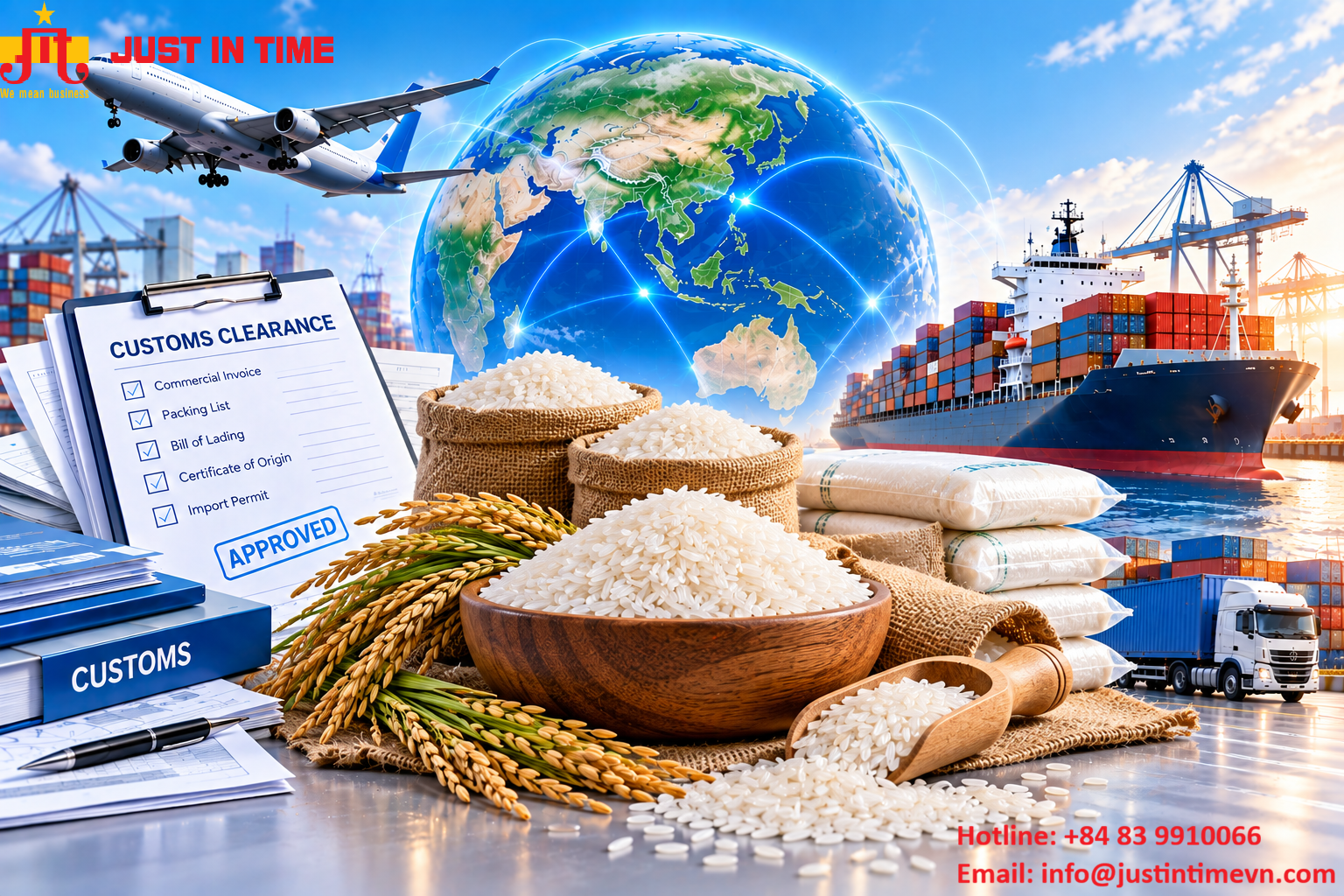
1. Product and Import Policy for Rice
1.1. Common Types of Imported Rice
Imported rice can be classified according to its milling status, variety, intended use, and processing characteristics. Common types include:
-
Paddy Rice: Unmilled rice with the husk intact, which may be imported for milling or planting purposes, depending on the product type.
-
Brown Rice: Rice from which the husk has been removed but the bran layer remains.
-
Milled Rice: Rice that has undergone milling and may or may not have been polished.
-
Fragrant Rice: Includes varieties such as Hom Mali, Basmati, and other aromatic rice varieties.
-
Glutinous Rice: Rice with a high amylopectin content, commonly used in food processing.
-
Parboiled Rice: Rice that has undergone soaking, steaming, or partial cooking before milling.
-
Broken Rice: Fragments of rice grains generated during milling, used in food processing or as animal feed ingredients, depending on the product.
Accurately identifying the type of rice is important for determining the HS code, applicable duties, and import requirements.
1.2. Import Policy for Rice
Rice is not generally classified as a prohibited import. However, because it is an agricultural commodity of plant origin, it may be subject to plant quarantine and applicable food-related management requirements, depending on the product type, intended use, and relevant regulations.
When importing rice, businesses should check the following:
-
The HS code applicable to each type of rice.
-
Import duties and eligibility for preferential tariff treatment.
-
Plant quarantine requirements for the shipment.
-
Import conditions and quarantine requirements applicable to the country of origin.
-
State food safety inspection requirements, where applicable.
-
Product labeling and Vietnamese supplementary labeling requirements.
-
Reporting obligations relating to rice import trading activities under current regulations.
Decree No. 365/2026/ND-CP, dated September 23, 2026, and effective October 1, 2026, governs rice import and export trading activities. Circular No. 65/2026/TT-BCT provides guidance on certain related matters, including reporting requirements for rice import trading activities.
Businesses should distinguish between the licensing conditions applicable to rice exporters and the obligations applicable to rice importers. Requirements for a Certificate of Eligibility for Rice Export Business should not automatically be assumed to apply to rice imports.
1.3. Plant Quarantine Requirements for Imported Rice
Rice and paddy fall within the category of plant-origin commodities that must be assessed under applicable plant quarantine regulations. HS codes under heading 1006, covering paddy, brown rice, milled rice, and broken rice, must be reviewed against the applicable plant quarantine requirements.
Depending on the product and country of origin, businesses should determine:
-
Whether the shipment must be registered for plant quarantine upon importation.
-
Whether a pest risk analysis or an import plant quarantine permit is required before shipment arrival.
-
Whether the exporter must provide a Phytosanitary Certificate issued by the competent authority in the exporting country.
-
The required documentation, inspection procedures, and quarantine treatment requirements when the goods arrive in Vietnam.
Businesses should not assume that all types of rice from every country are subject to the same import permit and quarantine requirements. The rice type, HS code, country of origin, and current plant quarantine regulations must be checked before signing the contract.
1.4. Food Safety Inspection for Imported Rice
For rice imported for food use, businesses must determine whether state food safety inspection is required under current regulations.
Depending on the product and intended use, businesses should check:
-
Whether the product is subject to state food safety inspection upon importation.
-
Whether the shipment qualifies for an applicable inspection exemption.
-
The quality and food safety indicators that must be satisfied.
-
Product labeling, ingredient information, and country-of-origin requirements.
-
Other specialized procedures if the rice is imported for planting, animal feed, or other specific purposes.
Ordinary rice used as a raw material should not automatically be assumed to require the same product self-declaration procedures as all processed and packaged foods. The applicable obligations must be determined based on the product and the relevant regulations.
2. HS Codes for Imported Rice
The HS code is an important basis for determining import duties, VAT, plant quarantine requirements, and other related management obligations.
Rice is classified under HS heading 1006 of Vietnam's Nomenclature of Export and Import Goods.
2.1. Reference HS Codes for Rice
Commonly encountered detailed HS codes under heading 1006 include:
|
Reference HS Code |
Product Description |
|
1006.10.10 |
Paddy suitable for sowing |
|
1006.10.90 |
Other paddy |
|
1006.20.10 |
Hom Mali brown rice |
|
1006.20.90 |
Other brown rice |
|
1006.30.30 |
Milled glutinous rice |
|
1006.30.40 |
Milled Hom Mali rice |
|
1006.30.50 |
Milled Basmati rice |
|
1006.30.60 |
Milled Malys rice |
|
1006.30.70 |
Other fragrant rice |
|
1006.30.91 |
Parboiled rice |
|
1006.30.99 |
Other milled rice |
|
1006.40.10 |
Broken rice suitable for use as animal feed |
|
1006.40.90 |
Other broken rice |
The above codes are provided as references for rice product classifications. When making an actual customs declaration, businesses must verify the detailed descriptions in the current tariff schedule and ensure that the selected code matches the actual shipment.
2.2. Basis for Determining the HS Code for Rice
When determining the HS code, businesses should check the following factors:
-
Whether the goods are paddy, brown rice, white rice, or broken rice.
-
Whether the rice has been fully milled or only partially processed.
-
Rice variety, such as glutinous rice, Hom Mali, Basmati, or other fragrant rice.
-
Whether the rice has undergone parboiling.
-
Intended use, including food consumption, food processing, animal feed, or planting.
-
Product composition, processing method, and identifying characteristics.
-
Technical documentation, Certificate of Analysis (COA), and supplier documents.
The HS code should not be determined solely from commercial names such as White Rice, Brown Rice, or Jasmine Rice. Particular attention should be paid to the tariff descriptions for seed rice, parboiled rice, and broken rice.
If a product has complex characteristics or the appropriate code cannot be established, businesses may consider applying for an advance tariff classification determination in accordance with customs regulations.
3. Import Duties and VAT on Rice
Import duties on rice depend on the HS code, rice type, country of origin, and eligibility for preferential tariff treatment. VAT must be determined based on the nature of the product and the applicable VAT regulations.
3.1. Import Duties on Rice
According to the 2026 import tariff schedule used for reference, many types of paddy, brown rice, milled rice, and broken rice are subject to a preferential import duty rate of 40%. However, different rates may apply to seed rice or shipments eligible for preferential treatment under trade agreements.
Some reference preferential import duty rates are shown below:
|
Rice Type |
Reference HS Code |
Reference Preferential Import Duty |
|
Paddy suitable for sowing |
1006.10.10 |
0% |
|
Other paddy |
1006.10.90 |
40% |
|
Hom Mali brown rice |
1006.20.10 |
40% |
|
Other brown rice |
1006.20.90 |
40% |
|
Milled glutinous rice |
1006.30.30 |
40% |
|
Milled Hom Mali rice |
1006.30.40 |
40% |
|
Milled Basmati rice |
1006.30.50 |
40% |
|
Other fragrant rice |
1006.30.70 |
40% |
|
Parboiled rice |
1006.30.91 |
40% |
|
Other milled rice |
1006.30.99 |
40% |
|
Broken rice |
1006.40.10 or 1006.40.90 |
40% |
The table is provided for reference only and does not replace verification of the detailed HS code for the actual shipment. Ordinary import duty and special preferential import duty may differ from the rates shown above.
Businesses should distinguish between the following types of import duty:
-
Preferential Import Duty: Applied under Vietnam's preferential import tariff schedule.
-
Special Preferential Import Duty: May apply if the goods satisfy the origin and documentary requirements of the relevant trade agreement.
-
Ordinary Import Duty: Applied in accordance with regulations to goods that do not qualify for preferential tariff treatment.
For rice imported from countries that have trade agreements with Vietnam, businesses should verify the HS code, country of origin, applicable origin criteria, and C/O. A single preferential rate should not be applied to rice from all exporting countries.
3.2. Value Added Tax (VAT)
For rice that has not been processed into another product or has undergone only ordinary preliminary processing, businesses should consider the rules governing goods not subject to VAT at the import stage under the Law on Value Added Tax No. 48/2024/QH15 and its current amendments and implementing regulations.
Ordinary preliminary processing may include cleaning, drying, dehusking, milling, and polishing grains. Therefore, ordinary rice that has undergone only these processes may qualify as goods not subject to VAT at the import stage, provided that all applicable legal conditions are satisfied.
For rice processed into other products, seasoned rice, or rice products with different processing characteristics, businesses must reassess the VAT treatment based on the actual nature of the goods.
Businesses should not assume that every product classified under HS heading 1006 is subject to the same VAT treatment. Where the goods do not qualify for VAT exemption, the applicable rate must be verified under current regulations.
3.3. Example of Import Tax Calculation for Rice
Assume that a business imports milled rice with the following hypothetical information:
-
Import taxable value: VND 500,000,000.
-
Assumed preferential import duty rate: 40%.
-
The rice qualifies as goods not subject to VAT at the import stage under the applicable regulations.
Import duty:
VND 500,000,000 × 40% = VND 200,000,000.
VAT at the import stage:
VND 0, assuming the shipment fully satisfies the conditions for VAT exemption.
Total import duty and VAT:
VND 200,000,000 + VND 0 = VND 200,000,000.
This example is provided solely to illustrate the calculation method under a hypothetical scenario. For an actual shipment, businesses must determine the correct HS code, country of origin, duty rate, and eligibility for VAT exemption on the date of customs declaration.
** See more Import Procedures for Agricultural and Seafood Dryers
4. Import Documentation for Rice
The import dossier for rice must be properly prepared to support customs declaration, plant quarantine, and any other applicable specialized procedures.
4.1. Standard Customs Documentation
The standard import dossier for rice generally includes:
-
Import customs declaration.
-
Commercial Invoice.
-
Packing List, where applicable.
-
Sales Contract, where applicable.
-
Bill of Lading or Air Waybill.
-
Certificate of Origin (C/O), if available and required for preferential tariff treatment.
-
Documents describing the rice variety, quality, and packaging specifications.
-
Other documents required by the customs authorities.
4.2. Plant Quarantine Documentation
Depending on the rice type and applicable requirements, businesses may need to prepare:
-
Application for import plant quarantine.
-
Phytosanitary Certificate issued by the competent authority in the exporting country, where required.
-
Import plant quarantine permit, where applicable.
-
Documents concerning the country of origin and source of the goods.
-
Additional documents or information requested by the plant quarantine authority.
Businesses should determine in advance whether the shipment is subject to pest risk analysis or specific quarantine conditions. These requirements should be checked before shipment to minimize additional expenses at the port.
4.3. Food Safety Documentation
If the shipment is subject to state food safety inspection, businesses must prepare the required documents according to the applicable inspection method. These may include:
-
Application for state food safety inspection of imported goods.
-
Product self-declaration or product registration dossier, where mandatory.
-
Test reports or a Certificate of Analysis, where required.
-
Packing List.
-
Other relevant documents required under the regulations.
Not every rice shipment requires the same product declaration documentation. Businesses should identify the rice type, intended use, and applicable management category before preparing the dossier.
5. Rice Import Procedures
Step 1: Identify the Type of Rice
Determine whether the goods are paddy, brown rice, white rice, fragrant rice, glutinous rice, parboiled rice, or broken rice. Clarify whether the intended use is food consumption, manufacturing, animal feed, or planting.
Step 2: Check the Import Policy
Review trade management regulations, plant quarantine requirements, food safety regulations, and other specialized requirements applicable to the product and country of origin.
Step 3: Check Plant Quarantine Requirements
Verify the HS code and applicable quarantine requirements. Determine whether the shipment requires a Phytosanitary Certificate, an import permit, or pest risk analysis before transportation.
Step 4: Determine the HS Code
Select the appropriate HS code based on the condition and characteristics of the rice. In particular, distinguish between paddy, brown rice, milled rice, parboiled rice, and broken rice.
Step 5: Check Duties and Proof of Origin
Check the current tariff schedule based on the HS code and country of origin. If the goods may qualify for special preferential import duty, verify the C/O and the corresponding origin requirements.
Step 6: Prepare the Import Documentation
Prepare the Commercial Invoice, Packing List, Sales Contract where applicable, transport document, C/O where relevant, and any required quality documentation.
Step 7: Register for Plant Quarantine and Other Specialized Procedures
Register for plant quarantine in accordance with applicable regulations. If the shipment is subject to state food safety inspection, prepare and submit the required documents under the relevant inspection method.
Step 8: Submit the Customs Declaration
Submit the electronic customs declaration with accurate information about the product name, HS code, quantity, customs value, country of origin, and intended use.
Step 9: Document Review and Goods Inspection
The customs authorities review the documents or conduct a physical inspection depending on the customs channel. Plant quarantine authorities and other relevant specialized agencies carry out the procedures within their respective areas of responsibility.
Step 10: Pay Taxes and Complete Customs Clearance
Fulfill the applicable tax obligations and complete all customs clearance requirements relevant to the shipment. Once the conditions have been satisfied, collect the goods and transport them to the warehouse.
Step 11: Fulfill Rice Import Reporting Obligations
Under Decree No. 365/2026/ND-CP and Circular No. 65/2026/TT-BCT, rice importers must fulfill reporting obligations concerning their rice import trading activities.
Periodic reports are submitted through the Ministry of Industry and Trade's reporting system. Under the applicable guidance, quarterly reports must be submitted before the 15th day of the first month of the following quarter, while annual reports must be submitted before January 15 of the following year. Businesses must also submit ad hoc reports when requested.
6. Important Considerations When Importing Rice
6.1. Check Plant Quarantine Requirements Before Signing the Contract
Rice is a plant-origin commodity and must be checked against the applicable quarantine lists and import conditions. Businesses should verify the requirements based on the HS code, country of origin, and type of rice before arranging transportation.
6.2. Determine the Correct HS Code Based on the Condition of the Goods
Paddy, brown rice, milled rice, and broken rice fall under different subheadings within heading 1006. Incorrect classification may result in an incorrect duty rate, misapplication of quarantine requirements, or requests for clarification from customs authorities.
6.3. Check Eligibility for Preferential Tariff Treatment
Import duties on rice may differ depending on the country of origin, rice type, and applicable trade agreement. Businesses should verify the C/O, origin criteria, and related conditions rather than relying solely on the country from which the goods are shipped.
6.4. Determine the Correct VAT Treatment
Rice that has not been processed into another product or has undergone only ordinary preliminary processing may qualify as goods not subject to VAT at the import stage. However, products that have undergone different processing must be reassessed based on their composition and actual manufacturing process.
6.5. Check Quality and Storage Conditions
Rice should be stored under conditions that minimize mold, insect infestation, and contamination. Businesses should check packaging, grain quality, moisture content, and applicable food safety indicators according to product requirements and the intended market.
6.6. Comply with Rice Import Reporting Obligations
This is an important consideration under the regulations that took effect on October 1, 2026. Rice importers should check the applicable reporting requirements, deadlines, and procedures for ad hoc reports under Decree No. 365/2026/ND-CP and Circular No. 65/2026/TT-BCT.
6.7. Estimate All Import Costs
In addition to import duty and any other applicable taxes, businesses should budget for:
-
International freight.
-
Local charges at the port.
-
Customs declaration fees.
-
Plant quarantine fees.
-
Testing or food safety inspection fees, where applicable.
-
Container storage, port storage, and handling charges.
-
Inland transportation costs.
-
Storage and handling costs.
A comprehensive cost estimate helps businesses manage the landed cost and minimize unexpected expenses when the goods arrive at the port.
** See more Import Procedures for Harrows
7. Rice Import Services
For businesses with limited experience in importing rice, checking country-specific import policies, determining the HS code, and preparing plant quarantine documentation may involve several procedures requiring coordination.
Import and logistics service providers may assist businesses with:
-
Advising on rice import policies according to the product type and country of origin.
-
Supporting preliminary HS code classification.
-
Checking import duties and VAT treatment.
-
Reviewing plant quarantine requirements.
-
Advising on food safety inspection documentation, where applicable.
-
Preparing import documents and submitting customs declarations.
-
Monitoring document review and customs clearance.
-
Arranging international freight, domestic transportation, and delivery.
-
Advising on rice import reporting obligations under the current regulations.
Businesses should provide complete information about the rice variety, country of origin, intended use, packaging specifications, and supplier documents from the outset to determine the applicable import procedures accurately.
8. FAQ – Frequently Asked Questions About Importing Rice
8.1. Does importing rice require an import license?
Ordinary rice does not automatically require a separate import license in every case. However, businesses must check plant quarantine requirements, specialized import permits where applicable, and reporting obligations relating to rice import trading activities under current regulations.
8.2. Is plant quarantine required when importing rice?
Rice and paddy must be assessed under applicable plant quarantine regulations. The specific obligations, documentation, and import conditions must be determined based on the HS code, rice type, and country of origin.
8.3. What is the HS code for rice?
Rice is classified under HS heading 1006. Paddy may fall under subheading 1006.10, brown rice under 1006.20, milled rice under 1006.30, and broken rice under 1006.40. The detailed HS code must be determined based on the actual condition, variety, and intended use of the goods.
8.4. What is the import duty on rice?
According to the referenced tariff information, many types of ordinary rice are subject to a preferential import duty rate of 40%, while paddy suitable for sowing and certain shipments eligible for preferential treatment under trade agreements may be subject to different rates. Businesses must verify the correct HS code, country of origin, and supporting documents to determine the actual duty rate.
8.5. Is imported rice subject to VAT?
Rice that has not been processed into another product or has undergone only ordinary preliminary processing may qualify as goods not subject to VAT at the import stage under the Law on Value Added Tax and its implementing regulations. For rice products that have undergone additional processing, the VAT treatment must be checked based on the actual characteristics of the goods.
8.6. Is a C/O required when importing rice?
A C/O is not always mandatory for every shipment. However, if a business wants to claim special preferential import duty under a trade agreement, it must satisfy the applicable origin requirements and provide valid supporting documents.
8.7. Must rice importers submit reports to the Ministry of Industry and Trade?
Under the regulations effective October 1, 2026, rice importers must fulfill reporting obligations concerning rice import trading activities under Decree No. 365/2026/ND-CP and Circular No. 65/2026/TT-BCT. Periodic and ad hoc reports must be submitted according to the applicable deadlines and procedures.
9. Conclusion
Rice import procedures in Vietnam require careful review of HS classification, import duties, VAT treatment, plant quarantine, and food safety requirements where applicable. Because rice comes in various types and processing conditions, businesses should not apply one HS code or one duty rate to every rice product.
In particular, businesses should pay attention to Decree No. 365/2026/ND-CP and Circular No. 65/2026/TT-BCT, which took effect on October 1, 2026, and establish the reporting obligations applicable to their rice import trading activities. These reporting obligations must be fulfilled alongside customs procedures and specialized import requirements.
Before importing, businesses should accurately identify the rice type, verify quarantine requirements based on the country of origin, check the applicable tariff schedule, and prepare complete documentation. Completing these checks in advance helps minimize tax, quarantine, documentation, and customs clearance risks.
Legal References:
-
Decree No. 365/2026/ND-CP on rice import and export trading activities.
-
Circular No. 65/2026/TT-BCT providing guidance on the implementation of Decree No. 365/2026/ND-CP.
-
Circular No. 14/2024/TT-BNNPTNT on the list of regulated plant quarantine articles, together with any applicable amendments and supplements.
-
Law on Value Added Tax No. 48/2024/QH15 and its current amendments and implementing regulations.
-
Decree No. 181/2025/ND-CP detailing the implementation of certain provisions of the Law on Value Added Tax.
-
The current import tariff schedule applicable to HS heading 1006.
Note: The HS codes and tax rates in this article are provided for reference only. Businesses should verify the actual characteristics of the goods, country of origin, applicable tariff schedule, and specialized regulations in force on the date of customs declaration before importing.
If you have difficulties when clearing customs, you can choose Just In Time as a companion.
Just In Time's staff is always enthusiastic to support you to handle your work quickly and professionally.
JUST IN TIME JOINT STOCK COMPANY
Address: No. 5, Dong Da, Tan Son Hoa Ward, Ho Chi Minh City
Hotline: +84 83 9910066
Email: info@justintimevn.com
Facebook: https://www.facebook.com/justintimevn
** See more Food Dehydrators Import Procedures